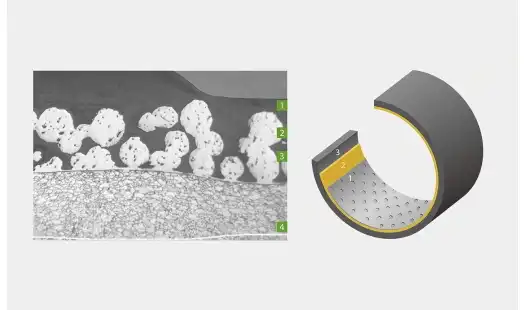
When it comes to choosing between sliding bearings and rolling bearings, engineers and architects confront a vital choice that can altogether affect the execution, effectiveness, and life span of their equipment. This comprehensive direct dive into the key contrasts, preferences, and applications of both bearing sorts gives you the information required to make an educated choice. We'll investigate components such as stack capacity, grinding, speed, and natural considerations to assist you in deciding which bearing type best suits your particular requirements.
Choosing between sliding bearings (plain bearings) and rolling bearings (anti-friction bearings like ball or roller bearings) is a common engineering decision with significant impact on performance, cost, and maintenance. Here's a practical guide to help you select the right type for your application.
Welcome visit EPEN Sliding bearing factory:

Overview
Operate on a sliding contact principle (shaft slides on bearing surface).
Require lubrication to separate surfaces and minimize wear.
Examples: sleeve bearings, journal bearings, bushings.
Rolling Bearings
Operate on a rolling contact principle (elements like balls or rollers reduce friction).
Typically contain rolling elements between inner and outer rings.
Examples: ball bearings, roller bearings, needle bearings.
Key Selection Criteria
| Criteria |
Sliding Bearings |
Rolling Bearings |
| Friction |
Higher at start-up, lower at high speeds |
Lower at start-up, higher at very high speeds |
| Load Capacity |
Excellent for high radial/impact loads |
Better for combined loads (radial+axial) |
| Speed Capability |
Excellent for very high speeds |
Limited by centrifugal forces |
| Space Requirements |
Compact radial design |
Larger radial space needed |
| Noise/Damping |
Quieter, damp vibrations |
Can be noisier, transmit vibrations |
| Maintenance |
Often requires continuous lubrication |
Sealed/lubricated-for-life options available |
| Initial Cost |
Generally lower |
Generally higher |
| Precision & Stiffness |
Lower running accuracy |
High precision and stiffness |
| Life Expectancy |
Unlimited if properly lubricated |
Finite (calculated L10 life) |
When to Choose Each Type
Choose Sliding Bearings When:
Extreme load conditions exist (shock, vibration, heavy loads)
Very high rotational speeds are required
Space is limited radially but available axially
Noise reduction is critical
Cost is a primary concern for simple applications
Dirty environments where contaminants can be embedded in soft materials
Alignment flexibility is needed between shaft and housing
Choose Rolling Bearings When:
Low starting friction is critical
Precise shaft positioning is required
Combined loads (radial + axial) must be supported
Standardization and interchangeability are important
Minimal maintenance is desired (sealed versions)
High efficiency at low to moderate speeds is needed
Easy installation and replacement are priorities
Practical Application Examples
Sliding Bearing Applications:
Internal combustion engine crankshafts
Turbine and compressor shafts
Machine tool spindles
Marine propeller shafts
Heavy machinery pivot points
Rolling Bearing Applications:
Electric motor shafts
Gearboxes and transmissions
Conveyor rollers
Automotive wheels
Household appliances
Lubrication Considerations
Sliding Bearings:
Require continuous lubrication system in demanding applications
Can use hydrodynamic, hydrostatic, or boundary lubrication
Oil selection critical for viscosity and film formation
Rolling Bearings:
Often use grease for life or re-lubrication intervals
Oil lubrication for high-speed or high-temperature applications
Sealed bearings eliminate lubrication maintenance
Installation & Maintenance Tips
Sliding Bearings:
Require careful running-in period
Clearance adjustment is critical
Wear monitoring through oil analysis
Re-babbitting or replacement of bearing surface possible
Rolling Bearings:
Require precise fits and alignment
Preload adjustment important for some types
Failure is usually catastrophic (replace entire bearing)
Condition monitoring through vibration analysis
Common Pitfalls to Avoid
Overlooking start-up conditions - Sliding bearings have higher friction at start
Ignoring thermal considerations - Sliding bearings generate more heat at low speeds
Underestimating alignment requirements - Rolling bearings tolerate less misalignment
Forgetting lubrication needs - Both types fail without proper lubrication
Neglecting environmental factors - Contamination affects bearing types differently
Decision Flowchart
Start → Define application requirements (load, speed, space, environment)
Shock/vibration loads? → Yes → Consider sliding bearings
Very high speeds? → Yes → Consider sliding bearings
Low starting torque critical? → Yes → Consider rolling bearings
Precision positioning needed? → Yes → Consider rolling bearings
Space constraints? → Radial limitation → Rolling; Axial limitation → Sliding
Maintenance requirements? → Minimal → Sealed rolling bearings
Cost sensitivity? → High → Sliding bearings often cheaper initially
Evaluate alternatives → Consider hybrid solutions if needed
Final selection → Validate with specific manufacturer data
Conclusion
Choosing between sliding bearings and rolling bearings requires cautious thought of different variables, including stack capacity, speed requirements, environmental conditions, and support needs. Whereas sliding bearings exceed expectations in high-load, shock-resistant applications and unforgiving situations, rolling bearings offer focal points in high-speed, low-friction scenarios. Eventually, the best choice depends on the particular prerequisites of your application. By carefully assessing these components and counseling with bearing pros, you can guarantee ideal execution and life span for your apparatus.
For critical applications, consult bearing manufacturers early in the design process. Often, practical experience with similar applications provides the most reliable guidance, supplemented by computational analysis for load and life predictions. Consider total lifecycle costs, not just initial purchase price, when making your final selection.
FAQs
1. Can sliding bearings operate without lubrication?
Some sliding bearings, especially those made with self-lubricating materials, can operate with minimal or no external lubrication. However, most traditional sliding bearings require proper lubrication for optimal performance and longevity.
2. Are rolling bearings always more efficient than sliding bearings?
While rolling bearings generally have lower friction, especially at higher speeds, sliding bearings can be more efficient in certain applications, particularly those involving heavy loads or requiring shock absorption.
3. How do I determine the right bearing type for my application?
Consider factors such as load type and magnitude, operating speed, environmental conditions, and maintenance requirements. Consulting with a bearing specialist can help you make the best choice for your specific needs.
Expert Sliding Bearing Solutions | EPEN
At Jiashan Epen Bearing Co.Ltd, we specialize in manufacturing high-quality sliding bearings and wear plates for a wide range of industries. Our extensive product line includes metal-plastic composite bearings, bimetal bearings, and single metal sliding bearings, all designed to meet the highest standards of performance and durability. With our commitment to innovation and customer satisfaction, we're your ideal partner for all your sliding bearing needs. Contact us at epen@cnepen.cn to learn how our expert solutions can enhance your machinery's performance.
References
Smith, J. D. (2018). "Modern Tribology Handbook: Principles of Sliding and Rolling Bearings." CRC Press.
Johnson, K. L. (2019). "Contact Mechanics in Bearing Design." Cambridge University Press.
Williams, R. A. (2020). "Industrial Bearing Selection: A Comprehensive Guide." Elsevier.
Brown, M. E. (2017). "Aerospace Bearings: Advanced Materials and Applications." Wiley-Interscience.
Thompson, L. C. (2021). "Automotive Bearing Technology: From Engine to Wheel." SAE International.
Davis, H. G. (2019). "Maintenance Strategies for Industrial Bearings." Industrial Press, Inc.


_1760440080666.webp)