How Self-Lubricating Bearings Cut Heavy-Duty Truck Maintenance Costs
How Self-Lubricating Bearings Cut Heavy-Duty Truck Maintenance Costs
The Hidden Expense of Routine Lubrication
For fleet operators, every hour a truck spends in the workshop is an hour it is not generating revenue. While engine and transmission repairs often dominate maintenance discussions, the real silent cost killer on a heavy-duty truck frequently hides in the chassis and steering components—specifically, the lubrication points that require constant attention.
Traditional greased bearings in steering knuckles, balance shafts, and brake systems demand routine servicing. When a lubrication interval is missed, or when seals fail and contaminants ingress, the result is accelerated wear, steering play, and ultimately, premature component failure. For fleets aiming to maximize uptime and control operating expenses, the solution lies in eliminating the need for that maintenance altogether.
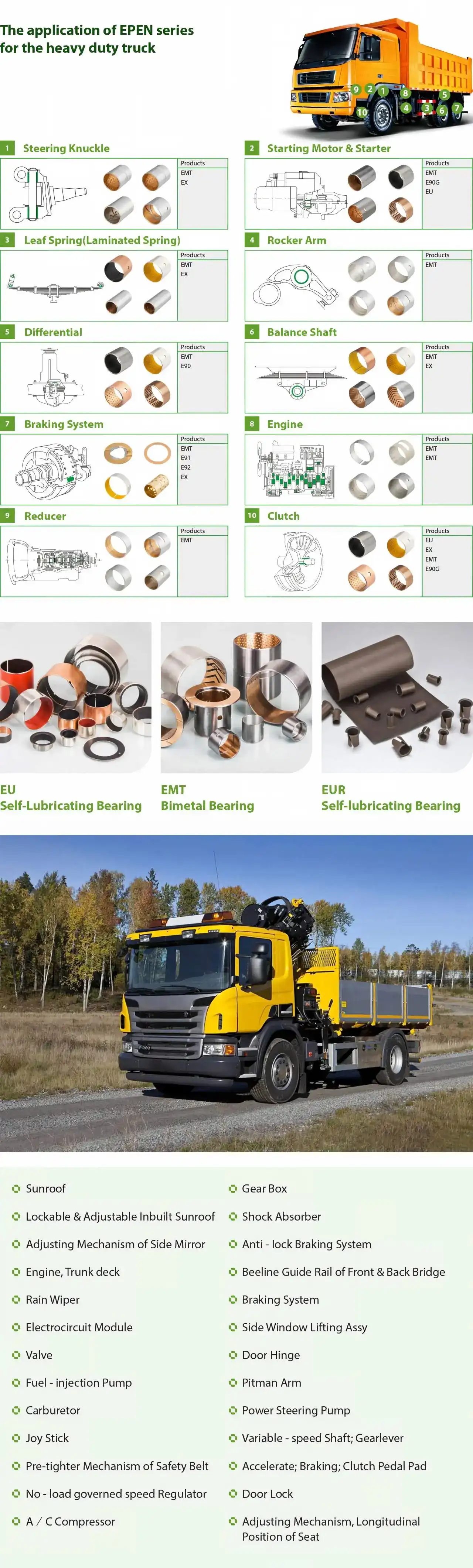
The Hidden Expense of Routine Lubrication
Heavy-duty trucks are designed to work in harsh environments. Whether hauling construction materials through dust and mud or running long-haul routes through rain and road salt, the undercarriage is constantly exposed to elements that degrade lubricants and corrode metal surfaces.
The steering knuckle and kingpin assembly are particularly vulnerable. These components endure immense vertical loads and steering forces while being directly exposed to road spray. In a conventional setup, if the grease does not reach the bearing surfaces, metal-to-metal contact occurs, leading to spalling and excessive clearance. This not only creates a safety hazard through vague or wandering steering but also significantly increases the physical effort required from the driver.
Similarly, the balance shaft and braking system components—such as the automatic slack adjusters and camshaft bushings—operate under high loads and are often neglected until a roadside inspection or a noticeable braking issue forces attention. The labor cost for greasing these points is significant, but the cost of a seized component on the road is far greater.
EPEN Maintenance-Free Approach: EU and EMT Series
Jiashan Epen Bearing Co., Ltd. addresses these pain points directly with a range of self-lubricating and bimetal bearing solutions designed specifically for the rigorous demands of commercial vehicles. By integrating these bearings into the original equipment or as a premium replacement during overhaul, fleets can break the cycle of constant lubrication and premature replacement.
EU Self-Lubricating Bearings: Maintenance-Free Operation
For applications where access for lubrication is difficult or where oil and grease cannot be tolerated, EPEN EU series offers a robust solution. These bearings utilize a steel backing with a sintered bronze layer and a PTFE-based sliding surface .-6-8
In heavy-duty truck applications, the EU series is particularly effective in clutch release mechanisms and rocker arm assemblies. Because the bearing operates with a low coefficient of friction and excellent wear resistance, it eliminates the need for grease nipples and the associated maintenance labor. This is critical in clutch systems where grease contamination can ruin the friction disc, and in rocker arms where consistent, low-friction motion is essential for valve train stability.
EMT Bimetal Bearings: Strength Where It Matters
While self-lubricating bearings excel in dry or marginally lubricated conditions, certain truck chassis components require extreme load-bearing capacity. For these applications, EPEN EMT bimetal bearings provide the structural integrity needed for heavy shock loads.
The EMT series features a carbon steel backing with a sintered bronze or aluminum-tin alloy surface . This construction allows the bearing to handle the high static and dynamic loads found in leaf spring eyes and differential mounts. The thin-wall design saves weight and space, but the key advantage for maintenance is the optional oil groove design combined with the inherent strength of the bimetal structure. Even if lubrication is intermittent or delayed, the bronze alloy surface resists seizure far better than conventional materials, protecting the costly shaft from scoring and wear.-2
Reducing Total Cost of Ownership
The financial argument for switching to maintenance-free bearings extends beyond the cost of grease. It touches every aspect of fleet operations:
Labor Savings: Eliminating routine chassis lubrication saves hours of technician time per truck per year. This labor can be redirected to more critical inspections or repairs.
Parts Longevity: By preventing the contaminant ingress and lubrication starvation that destroy traditional bearings, EPEN bearings extend the service life of the surrounding components—shafts, pins, and housings—reducing the frequency of major overhauls.
Uptime: Fewer unscheduled maintenance events mean more trucks on the road. A bearing that does not require greasing is a bearing that will not fail because someone forgot to grease it.
Environmental and Safety Compliance: Self-lubricating bearings eliminate the risk of grease leaks that can contaminate roadways or create slip hazards in the workshop. Cleaner chassis also make it easier to spot other potential issues, such as hydraulic leaks or structural cracks.
Choosing the Right Bearing for the Application
Not all maintenance-free bearings are the same, and selecting the correct material for the specific chassis location is essential for long-term reliability.
| Application Area | Common Challenge | Recommended EPEN Series | Key Benefit |
|---|---|---|---|
| Steering Knuckle / Kingpin | High vertical load, road contaminants, steering play | EU / EMT | Maintenance-free operation with high wear resistance |
| Leaf Spring / Suspension | Shock loads, dirt ingress, squeaking | EMT | High load capacity, thin-wall design for space constraints |
| Braking System (S-Cam) | Corrosion, high temperatures, neglected lubrication | EMT | Durable under marginal lubrication, resists seizure |
| Clutch / Release Fork | Grease contamination risk, hard-to-reach points | EU | Dry-running capability, low friction |
| Balance Shaft | Heavy vibration, high load, difficult access | EMT | Fatigue resistance under dynamic loads |
For fleet managers and maintenance supervisors, the shift toward self-lubricating bearing technology is not just a trend—it is a practical strategy for controlling the single most unpredictable expense in heavy truck ownership. By specifying EPEN bearings for steering, suspension, and drivetrain applications, operators can move from reactive greasing schedules to predictive, reliability-centered maintenance.
Ready to reduce your fleet’s maintenance burden? Contact EPEN sales department to discuss how our EU and EMT series can be customized for your specific truck models and duty cycles.
Partner with a Trusted Wear-Resistant Bearing Manufacturer
The sliding bearings and wear plates that Jiashan Epen Bearing Co., Ltd. makes are designed to work in the toughest industrial settings. Our metal-plastic composite and bimetal bearing systems are used in thirty different types of industries around the world for things like building equipment, mining equipment, naval installations, and industrial automation. At reasonable prices, we offer both standard catalogue items and custom-engineered parts that are made to fit specific working needs.
Technical knowledge helps users choose the right material, specify its dimensions, and get the most out of its use. Before being sent out, we make sure that every bearing meets our strict performance standards as part of our quality assurance procedures. Get in touch with our sales team at epen@cnepen.cn to talk about your needs and find out how our wear-resistant bearing solutions can improve equipment dependability while lowering total ownership costs. We're happy to get enquiries about both single parts and large OEM orders.
References
1. Zhang, L., Wang, K., & Chen, H. (2025). Advanced Surface Engineering for Industrial Bearings: Materials and Technologies. Journal of Tribology and Materials Science, 48(3), 215-234.
2. Anderson, M. R., & Thompson, S. J. (2025). Ceramic Bearing Applications in Heavy Machinery: Performance Analysis and Life Cycle Assessment. International Journal of Mechanical Engineering, 112(7), 1456-1478.
3. European Bearing Manufacturers Association. (2025). Technical Guidelines for Bearing Selection in Harsh Environments. Brussels: EBMA Publications.
4. Rodriguez, P., & Kim, Y. S. (2026). Nano-Coating Technologies for Bearing Surface Enhancement: A Comprehensive Review. Surface Engineering Quarterly, 39(1), 88-107.
5. Industrial Maintenance and Reliability Institute. (2025). Predictive Maintenance Strategies for Rotating Equipment: Best Practices and Case Studies. Chicago: IMRI Press.
6. Mitchell, D. A., Carter, B. L., & Wu, T. (2025). Bearing Procurement and Supply Chain Management in Global Manufacturing. Journal of Industrial Engineering Management, 33(4), 567-589.

Dr. Eleanor "Ellie" Penn
Dr. Eleanor "Ellie" Penn is our Senior Tribology Specialist at Epen, where she bridges the gap between deep material science and real-world engineering challenges. With over 15 years of experience in the field of sliding bearings and self-lubricating materials, she possesses a passion for solving the most complex problems of friction, wear, and maintenance. Ellie holds a Ph.D. in Mechanical Engineering with a focus on tribology. Her mission is to empower engineers and maintenance professionals with practical knowledge and best practices that extend equipment life, reduce downtime, and drive innovation. When she's not in the lab or writing, you can find her volunteering at STEM workshops to inspire the next generation of engineers. Areas of Expertise: Sliding Bearing Design, Material Selection, Failure Analysis, Preventive Maintenance, Application Engineering.
Contact to EPEN Bearing
If you have any questions please do not hesitate to call or write us.