The Correct Way to Store And Handle Sliding Bearings to Avoid Pre-Installation Damage
The Correct Way to Store And Handle Sliding Bearings to Avoid Pre-Installation Damage
Part 1: Why Pre-Installation Damage Is Often Overlooked
- Part 1: Why Pre-Installation Damage Is Often Overlooked
- Part 2: Environmental Requirements for Bearing Storage
- Part 3: Packaging Preservation — Do Not Remove Until Installation
- Part 4: Handling Procedures to Prevent Physical Damage
- Case Studies: How Proper Storage and Handling Extend Sliding Bearing Life
- Company Introduction and Product & Service Overview
- CNEPEN's Commitment to Quality — From Factory to Installation
- Conclusion
- FAQ
- Partner with Epen for Superior Sliding Bearing Solutions
- References
A sliding bearing is at its most vulnerable before it is ever installed. Between the moment a precision-engineered component leaves the factory and the moment it is pressed into its housing, countless risks threaten its performance and service life. Corrosion, contamination, physical deformation, and packaging degradation can all compromise a bearing that was manufactured to exacting specifications.
Industry data suggests that a significant percentage of bearing failures attributed to "contamination" or "installation damage" actually originate during storage and handling — not during the installation process itself. The economic impact is substantial: damaged bearings must be scrapped or returned, causing project delays, expedited shipping costs, and quality disputes between buyers and suppliers.
For engineers, maintenance professionals, and procurement teams sourcing sliding bearings from CNEPEN, understanding proper storage and handling protocols is essential to preserving the value and performance of these critical components.
This article provides a comprehensive, step-by-step guide to the correct storage and handling of sliding bearings, covering environmental controls, packaging preservation, handling techniques, shelf life management, and inspection procedures before installation.
Part 1: Why Pre-Installation Damage Is Often Overlooked
1.1 The Hidden Cost of Improper Storage
Sliding bearings — whether self-lubricating bushings, bi-metal bearings, or bronze wrapped varieties — are manufactured to tight tolerances. A typical plain bearing has critical dimensions measured in hundredths of a millimeter, and sliding surfaces with roughness values (Ra) below 0.8 micrometers.
When these precision components are stored incorrectly, the damage is often invisible to the naked eye but catastrophic in operation:
| Damage Type | Cause | Consequence |
|---|---|---|
| Corrosion (rust) | High humidity, condensation, aggressive atmosphere | Pitted sliding surface, increased friction, premature wear |
| Contamination | Dust, dirt, airborne particles | Embedded abrasives, scoring of shaft and bearing |
| Deformation (out-of-round) | Stacking heavy boxes, improper racking | Binding during installation, altered clearance |
| Lubricant degradation | Temperature extremes, UV exposure, long storage | Reduced lubricity, increased starting torque |
| Packaging damage | Punctured bags, torn wrappers | Loss of corrosion protection, contamination ingress |
1.2 The OEM and Distributor Perspective
For OEMs maintaining inventory of plain bearings, improper storage leads to quality escapes — bearings that pass incoming inspection (visual only) but fail in the field due to hidden corrosion or lubricant degradation.
For distributors, damaged inventory means write-offs, customer returns, and reputational damage. For maintenance teams, a bearing that fails immediately after installation is often incorrectly blamed on the component quality rather than the storage conditions that preceded installation.
Part 2: Environmental Requirements for Bearing Storage
2.1 Temperature Control
Sliding bearings, particularly those with composite structures (steel backing + bronze sintered layer + PTFE/POM top layer), are sensitive to extreme temperatures.
| Parameter | Recommended Range | Risk Outside Range |
|---|---|---|
| Storage temperature | 10°C to 30°C (50°F to 86°F) | PTFE/POM degradation above 50°C; condensation below dew point |
| Daily temperature fluctuation | ±5°C maximum | Condensation inside packaging |
| Avoid direct sunlight | Always | UV degradation of polymer lubricants; localized heating |
Why temperature matters: The PTFE or POM lubrication layer in self-lubricating bushings can undergo property changes at elevated temperatures. While the operating temperature range is broad (-40°C to +110°C for PTFE variants), prolonged storage above 50°C accelerates aging of the polymer matrix.
2.2 Humidity Control
Corrosion is the single greatest threat to ferrous bearing components during storage.
| Parameter | Recommended Range | Control Method |
|---|---|---|
| Relative humidity (RH) | 40% to 60% | Dehumidifier in storage area |
| Maximum RH (short-term) | 65% (less than 48 hours) | Desiccant packs inside sealed packaging |
| Absolute prohibition | Condensation (any) | Avoid cold-to-warm temperature transitions |
The condensation trap: The most common cause of rust on stored bearings is not high ambient humidity — it is moving bearings from a cold warehouse to a warm assembly area. Warm air holds more moisture, which condenses on the cold metal surface. Always allow bearings to acclimate to room temperature inside their sealed packaging before opening.
2.3 Atmospheric Contaminants
Certain airborne chemicals accelerate bearing corrosion or degrade lubricants:
| Contaminant | Source | Effect |
|---|---|---|
| Sulfur compounds | Industrial areas near refineries, paper mills | Corrosion of steel backing |
| Chlorides | Coastal areas (salt spray), cleaning chemicals | Pitting corrosion |
| Ozone | Electric motors, welding operations | Degradation of elastomeric seals (if present) |
| Dust and particulates | Unfiltered air, construction nearby | Abrasive contamination |
Storage location priority:
- Climate-controlled indoor storage (ideal)
- Sealed warehouse with dehumidification (acceptable)
- Covered but unsealed area (only for short-term, heavy-duty bearings)
- Outdoor storage (never acceptable for precision sliding bearings)
Part 3: Packaging Preservation — Do Not Remove Until Installation
3.1 Understanding Factory Packaging
Sliding bearings leave the factory with specific packaging designed to protect them through the supply chain:
| Packaging Type | Protection Provided | When to Remove |
|---|---|---|
| VCI (Vapor Corrosion Inhibitor) bag | Rust protection via chemical vapor layer | Immediately before installation |
| Heat-sealed polybag | Physical barrier against dust and moisture | Immediately before installation |
| Oil or grease coating | Contact corrosion protection | Clean off per installation instructions |
| Individual carton | Physical protection against deformation | At installation station |
| Master carton/pallet | Protection during transport | As late as possible |
Critical rule: Never open sealed packaging until the moment of installation. Once opened, the protective atmosphere or vapor corrosion inhibitor dissipates, and the bearing becomes vulnerable.
3.2 Shelf Life Considerations
Different sliding bearing types have different shelf life limits:
| Bearing Type | Typical Shelf Life (factory-sealed) | After Opening |
|---|---|---|
| PTFE composite (dry) | 10+ years (no degradation) | Indefinite if stored in clean, dry environment |
| POM composite | 5+ years (minor polymer aging possible) | Indefinite but inspect for surface changes |
| Oil-impregnated bronze | 3-5 years (oil migration possible) | 1 year (re-oil if stored longer) |
| Grease-lubricated | 2-3 years (grease separation) | 6 months (regrease if stored longer) |
| Corrosion-sensitive (uncoated steel) | 1 year in sealed VCI bag | Hours (in humid environment) |
FIFO inventory management: To avoid shelf life expiration, always rotate bearing stock using First-In-First-Out (FIFO) principles. For low-turnover items, consider ordering just-in-time rather than holding multi-year inventory.
3.3 Inspection of Incoming Packaging
Upon receiving a shipment of sliding bearings from CNEPEN, inspect the packaging for:
- Punctures or tears in outer and inner packaging
- Water stains indicating past moisture exposure
- Crushed corners suggesting impact damage
- Missing or illegible labels (batch codes, dates)
- Documentation: Retain the Certificate of Analysis (CoA) or Inspection Report that accompanies each batch. This document contains critical traceability information (batch code, material grade, dimensional results) needed if a quality issue arises later.
Part 4: Handling Procedures to Prevent Physical Damage
4.1 Lifting and Carrying
Sliding bearings are precision components, not structural beams. Rough handling causes invisible deformation.
| Do | Do Not |
|---|---|
| Use clean, padded hands or gloves | Drop bearings onto hard surfaces |
| Carry small bearings in trays or containers | Tumble bearings from bulk containers |
| Support larger bearings across their diameter | Carry by the flange (if present) |
| Use soft slings for heavy bearings (>10 kg) | Use metal hooks or chains |
The one-finger test: A common shop-floor trick — after handling, run a fingertip gently around the bearing's sliding surface. If you feel any edge or irregularity that should not be there, the bearing may have been impacted.
4.2 Protection from Contamination
Human hands are a significant source of contamination. Fingerprints contain salts and oils that can:
Corrode steel surfaces
Interfere with adhesive bonding (if the bearing will be bonded into a housing)
Attract dust and debris
Best practices:
Wear clean, lint-free gloves when handling bearings
If gloves are not available, handle by the non-sliding surfaces (OD, end faces)
Never touch the PTFE or POM sliding surface with bare fingers
Keep work surfaces clean and covered with paper or plastic sheeting
4.3 Storage Racking and Stacking
Physical deformation (out-of-roundness, flange bending) occurs when bearings are stored improperly.
| Bearing Size | Recommended Storage Method | Prohibited Method |
|---|---|---|
| Small (ID < 20mm) | Bulk in sealed bag, flat | Stacking heavy items on top |
| Medium (ID 20-80mm) | Rows on flat shelf, single layer | Vertical stacking of multiple layers |
| Large (ID > 80mm) | Individually boxed, on edge with support | Floor stacking exceeding 3 boxes high |
| Flanged bushings | Flange-up, not stacked | Stacking on flange edge (bends flange) |
Racking guidelines:
- Maximum stack height: 5 cartons for small bearings, 3 cartons for large bearings
- Do not store heavy items (tools, raw materials) above bearing storage
- Use dividers in bins to prevent bearings from contacting each other
Case Studies: How Proper Storage and Handling Extend Sliding Bearing Life
Industrial Machinery Success Story
A big company that makes packing equipment had problems with sliding bearings in high-speed conveyor systems that kept happening. This caused unplanned downtime and high repair costs. An investigation showed that their building wasn't set up properly for storage, so bearings were exposed to changes in temperature and humidity levels that were higher than what is suggested. Corrosion on the sides of bearings caused early wear and decreased their useful life by about 40%.
Putting in place controlled storage areas with systems that check the temperature and humidity got rid of natural damage causes. Staff training on the right way to handle things cut down on mechanical damage, and better packaging security kept bearings in good shape during internal shipping operations. As a result of these changes, the bearings lasted over 60% longer and needed a lot less upkeep.
Marine Equipment Application Benefits
An offshore platform equipment seller had problems with how well bearings worked in rough marine environments, where the dependability of parts directly impacts working safety and the company's ability to make money. An analysis showed that poor storage and handling during the time before installation led to higher failure rates in important rotating equipment uses.
Creating specific storing guidelines for marine-grade bearings included adding more means to stop contamination and corrosion. By teaching repair workers the right way to handle parts, accidents involving damage were cut down, and quality control methods made sure that parts were complete before they were installed. The all-around method increased bearing life beyond industry standards and lowered the need for emergency replacements.
Company Introduction and Product & Service Overview
Epen's Manufacturing Excellence
Jiashan Epen Bearing Co., Ltd. is a leader in plain bearing technology because it combines cutting-edge manufacturing with thorough quality control programs. Our wide range of products includes metal-plastic hybrid bearings, bimetal bearings, and single metal series components made for tough industrial uses. As part of our ongoing research and development efforts, we use the newest developments in material science and manufacturing methods to make products with better performance.
Precision cutting and quality control methods in our factories make sure that all of our product lines meet the standards for size accuracy and surface finish. For common uses, standard catalog items are available right away, and custom engineering services can meet specific needs in building equipment, industrial machinery, and naval applications. Each bearing goes through strict inspection and testing processes that check its performance and size compliance.
Global Service and Support Capabilities
To serve both domestic and foreign customers, you need to know about the different rules and requirements for applications in many different businesses. Our expert support team helps customers choose the best bearings for their needs based on their working conditions and performance expectations through application engineering. A lot of paperwork, like technical data sheets, installation guides, and suggestions for routine upkeep, is needed for implementation to go smoothly.
Certification of materials, checking of dimensions, and performance tests that meet foreign standards and customer requirements are all part of quality assurance programs. Because we want to keep getting better, we keep investing in manufacturing technology and quality systems that give us accuracy, dependability, and cost-effectiveness benefits over our competitors. Epen is a reliable partner for long-term bearing supply contracts because of its commitment.
CNEPEN's Commitment to Quality — From Factory to Installation
At CNEPEN, quality assurance begins at the manufacturing stage and extends to packaging designed for global shipping and storage.
8.1 CNEPEN's Protective Packaging Standards
| Bearing Series | Standard Packaging | Corrosion Protection | Shelf Life (sealed) |
|---|---|---|---|
| EU Series (PTFE composite) | Heat-sealed polybag + VCI paper + carton | Multi-layer | 10+ years |
| EX Series (POM composite) | Heat-sealed polybag + desiccant + carton | Multi-layer | 5+ years |
| E90 Series (bronze wrapped) | VCI bag + foam insert + carton | Vapor corrosion inhibitor | 3 years |
| EMT Series (bi-metal) | Oil-coated + sealed polybag + carton | Contact oil + VCI | 2 years |
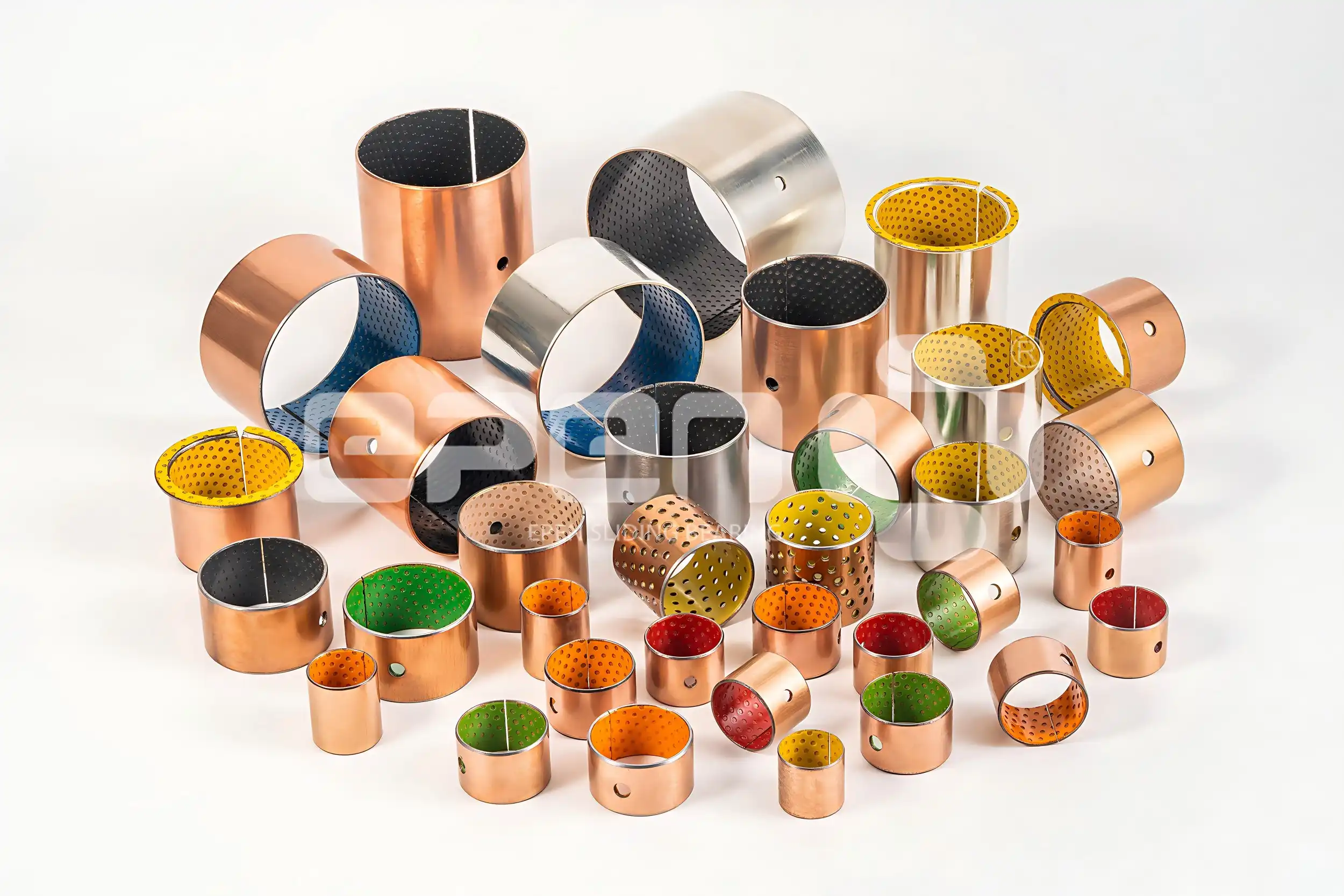
All self-lubricating bushings from CNEPEN are shipped with clear labeling including:
- Part number and description
- Batch/lot code (full traceability)
- Date of manufacture
- Storage and handling instructions
Conclusion
Implementing the right ways to store and handle sliding bearings is a basic requirement for keeping the parts in good shape and getting the best operating performance. Controlling the environment, following strict handling rules, and checking the quality all work together to stop damage before installation that could lower the life and dependability of the bearings. By understanding these concepts, procurement teams, support staff, and engineers can protect their investments and make sure that equipment works well in a wide range of workplace settings.
FAQ
How long can sliding bearings be stored without degradation?
If you keep the temperature between 15 and 25°C and the relative humidity below 60%, most sliding bearings can be kept safely for two to three years. Bearings that already have lubricants on them, on the other hand, may not last as long (12 to 18 months), based on the chemistry of the grease and how it is stored.
What are the key differences in storing oil-lubricated versus dry sliding bearings?
For oil-lubricated bearings, keeping them clean and away from weather changes that might change the lubricant's features is important. For dry bearings, the main goal is to keep them from rusting and breaking down. Both types benefit from environments with controlled humidity, but oiled bearings may need to be checked every so often to make sure the grease is still in good shape after being stored for a long time.
How can bearing integrity be maintained in humid environments?
To keep bearings in good shape when it's wet outside, better environmental controls are needed. These include dehumidification systems, packing that blocks moisture, and materials that absorb moisture. Keeping an eye on the storage conditions and bearings on a regular basis helps find problems before they affect the quality of the parts.
Partner with Epen for Superior Sliding Bearing Solutions
Epen is the best company to work with for your bearing needs because we are experts at making sliding bearings and are dedicated to quality excellence. With precision-engineered solutions, our wide range of products meets the needs of OEMs for building equipment, industrial tools, marine uses, and other specific needs. Get in touch with our technical team at epen@cnepen.cn to talk about your unique needs and find out how our cutting-edge bearing technology can help your tools work better. Epen has reliable sliding bearings that can meet the most demanding practical needs, whether you need normal catalog items or solutions that are specially designed for your needs.
References
Industrial Bearing Technology and Storage Best Practices, American Society of Mechanical Engineers, 2023.
Plain Bearing Performance and Maintenance Guidelines, International Organization for Standardization, 2022.
Environmental Effects on Bearing Materials and Storage Requirements, Journal of Tribology and Lubrication Engineering, 2023.
Quality Assurance in Industrial Bearing Manufacturing and Handling, Society of Tribologists and Lubrication Engineers, 2022.
Bearing Storage and Logistics Management for Industrial Applications, International Journal of Manufacturing Technology, 2023.
Corrosion Prevention and Material Protection in Bearing Storage Systems, Materials Science and Engineering Research, 2022.

Dr. Eleanor "Ellie" Penn
Dr. Eleanor "Ellie" Penn is our Senior Tribology Specialist at Epen, where she bridges the gap between deep material science and real-world engineering challenges. With over 15 years of experience in the field of sliding bearings and self-lubricating materials, she possesses a passion for solving the most complex problems of friction, wear, and maintenance. Ellie holds a Ph.D. in Mechanical Engineering with a focus on tribology. Her mission is to empower engineers and maintenance professionals with practical knowledge and best practices that extend equipment life, reduce downtime, and drive innovation. When she's not in the lab or writing, you can find her volunteering at STEM workshops to inspire the next generation of engineers. Areas of Expertise: Sliding Bearing Design, Material Selection, Failure Analysis, Preventive Maintenance, Application Engineering.
Contact to EPEN Bearing
If you have any questions please do not hesitate to call or write us.
Recommended Blog
Impact of Environmental Policies on Sliding Bearing Material Innovation
_1758800332230.webp)