How Bimetallic Bushings Handle High-Temperature Engine Loads
Understanding Bimetallic Bushings and Their Role in High-Temperature Engines
- Understanding Bimetallic Bushings and Their Role in High-Temperature Engines
- Comparing Bimetallic Bushings with Other Bearing Solutions for High-Temperature Applications
- Selection Guide: Choosing the Right Bimetallic Bushing for Your Engine Load Needs
- Installation, Maintenance, and Lifespan Optimization of Bimetallic Bushings
- Procurement Insights: Buying Bimetallic Bushings for High-Temperature Engine Applications
- Conclusion
- FAQ
- Partner with Epen for Reliable Bimetallic Bushing Solutions
- References
Bimetallic bushings manage high-temperature engine loads through their dual-layer construction that combines a rigid low-carbon steel backing with a friction-reducing alloy liner. This composite structure allows the steel backing to provide exceptional load-bearing capacity while the inner copper-lead or aluminum-tin alloy layer offers superior heat dissipation, anti-seizure properties, and embeddability for foreign particles. The design addresses thermal expansion challenges and maintains stable friction coefficients even when temperatures reach 250°C, making these plain bearings critical components in demanding engine applications where conventional bronze or polymer solutions fail.
Understanding Bimetallic Bushings and Their Role in High-Temperature Engines
The Engineering Behind Dual-Layer Construction
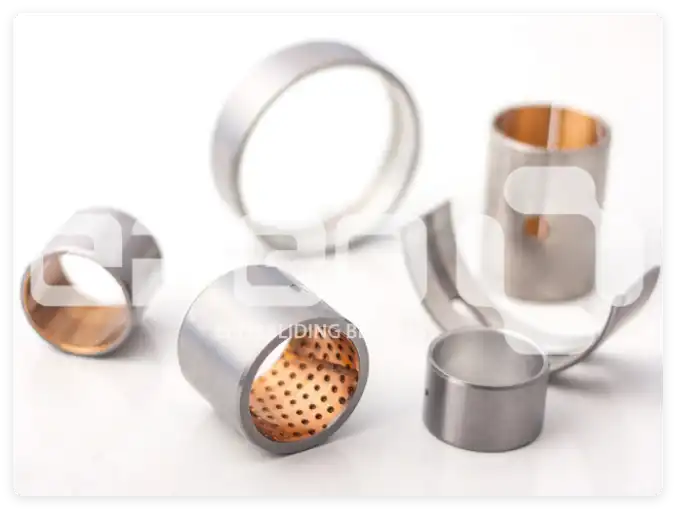
A bimetallic bushing's structure is a complex answer to tribological problems that arise in harsh settings. The steel backing, which is usually made from SAE 1010 low-carbon steel, gives the structure the stiffness it needs for high impact loads and interference fits inside engine housings. On the other hand, the lining made of a sintered alloy, usually CuPb10Sn10 (which is mostly copper and about 10% tin), acts as a sliding surface for the rotating shafts. When engineers choose bearings for heavy-duty machinery, they have to choose between mechanical strength and surface conformability. This stacked method solves the basic trade-off that engineers have to make.
Thermal Management Capabilities
Getting rid of heat is a very important part of engine bearing applications. The copper alloy lining in bimetallic bushings effectively moves heat away from surfaces that rub against each other, and it does this much better than polymer-based alternatives. When working temperatures get close to the highest limit of 250°C, the steel backing acts as a heat sink, and the alloy layer keeps its shape and ability to lubricate. This two-in-one thermal control stops the localised warming that causes conventional bearing designs to seize up and fail catastrophically.
Load Distribution Mechanics
Bimetallic bushings have very high wear strength even when the engine is moving. The CuPb10Sn10 mix meets standards like SAE 797 and ISO 3547, and it can handle a maximum steady load of 280 N/mm² and a maximum moving load of 140 N/mm². The bushing sleeve can handle the cyclic stresses that come with connecting rods, crankshaft supports, and pivot points that move back and forth in construction and industrial equipment because it meets these requirements.
Comparing Bimetallic Bushings with Other Bearing Solutions for High-Temperature Applications
Performance Against Bronze Bearings
Traditional solid brass bushings have been used in industry for many years, but they don't work well in high-temperature engine settings. Bronze is pretty good at resisting wear, but it can't handle heavy loads in harsh circumstances. Because they are backed by strengthened steel, bimetallic bushings work better than solid bronze because they don't bend under shock loads like bronze would when it cold flows. Bimetallic construction is also more cost-effective because the steel backing cuts down on the amount of expensive copper alloy that is needed. This saves material without affecting performance in heavy machinery applications like loader pivot points or excavator booms.
Advantages Over Polymer and Composite Options
Temperature limits make it hard for polymer bearings and fiber-reinforced composites to be used in engine applications. Most high-tech industrial plastics start to break down above 150°C, which is well below the temperature range where diesel engines and mine equipment's hydraulic systems can work. Bimetallic bushings keep the bearing gaps and sizes stable even when the temperature changes. This stops the thermal expansion mismatches that make polymer bearings seize up or get too much play. The hardness range of 70 to 100 HB is just right—it's tough enough to keep out abrasive contamination while still being soft enough to let particles stick that would otherwise score hardened shafts.
Specialized Applications in Harsh Environments
Corrosion protection and temperature efficiency are both important in marine and offshore engineering uses. Standard CuPb10Sn10 formulations are fine for most industrial needs. However, marine-grade bimetallic bushings use stronger alloys that can handle being exposed to saltwater in winch systems, rudder assemblies, and deck crane pivot points. The ability to embed materials is especially useful for the undercarriages of building equipment, where rough dust and grit are always a problem for the bearing surfaces. Because it has lead in it, foreign particles can get stuck in the lining instead of wearing away the bushing and shaft.
Selection Guide: Choosing the Right Bimetallic Bushing for Your Engine Load Needs
Assessing Operational Parameters
Before making a purchase choice, you should carefully look at the thermal and mechanical needs of your product. Engineers should write down the highest temperatures that a machine can handle, making a distinction between peak and continuous thermal exposure. In a high-performance diesel engine, the stress on a connecting rod bushing is different from that on an excavator's slowly oscillating boom pin. The load analysis has to take into account both the radial and axial parts, as well as the frequency of the shock loading and the sliding speed. Bimetallic bushings can handle speeds of up to 10 m/s when they are greased with oil, but they need to be more cautious when they are lubricated at the border.
Material Composition Considerations
The composition of the alloy lining has a direct effect on performance characteristics:
High-leaded bronze variants like CuPb24Sn4 are very flexible and can run in emergency situations when oil supply is temporarily cut off. This makes them ideal for farming equipment that works in dirty, poorly oiled conditions. The higher lead content makes it easier to install, but it also lowers the load capacity compared to balanced formulas.
Standard CuPb10Sn10 compositions work well in a wide range of heavy-duty situations. The right amounts of tin and lead make the fatigue power, seizure resistance, and wear properties better. This specification is the same as JIS LBC3 and ISO 3547, which means it will work with global OEM specs for mining equipment, building equipment, and industrial presses.
Lead-free aluminum-tin alloys meet health and environmental standards and are better at resisting corrosion. These mixtures work well in marine settings and on food processing equipment where lead content is a problem, but they usually need stricter lubrication schedules.
Dimensional Precision and Customization
Specifications for tolerances are very important in high-temperature situations where thermal expansion changes the clearances between bearings. To keep the fluid dynamic oil films necessary for keeping friction coefficients between 0.06 and 0.16, wall thickness tolerances must be kept within 0.01 mm. With custom sizing, you can use non-standard shaft lengths, which are popular in retrofit uses or machinery designs that aren't used very often. Length-to-diameter ratios affect how loads are distributed. Longer bushings spread forces more evenly, but they might be harder to install in tight spaces.
Supplier Evaluation Criteria
Quality certification makes sure that the methods used in making meet technical standards. ISO 3547 compliance shows that you follow internationally recognised standards for dimensions, materials, and performance. Suppliers should give material certificates that list the alloy's make-up, the thickness of the backing, and the strength of the bond between layers. The quality of the sintering process directly impacts the mechanical link between the alloy lining and steel backing. If the bonding is weak, the two layers will separate during thermal cycle. Manufacturers with a good reputation, like Jiashan Epen Bearing, follow strict quality testing and controlled sintering parameters to make sure that problems like these don't happen.
Installation, Maintenance, and Lifespan Optimization of Bimetallic Bushings
Proper Installation Techniques
Getting the best performance out of a bimetallic bushing starts with how it is installed. When you press-fit something, you need to pay close attention to the interference dimensions. If there is too much interference, residual stresses form that cause cracks, and if there is not enough interference, the bushing can spin inside its housing. To keep the bore shape from changing, the installation tools should apply equal pressing forces around the circle of the bushing. By chamfering the housing bores, you get rid of any sharp edges that could cut away material from the outside diameter of the bushing while it is being inserted. To keep edge loading from speeding up wear, the bushing bore and matching shaft must be lined up within certain limits.
Lubrication Requirements and Strategies
Even though lead bronze alloys naturally lubricate themselves, using the right kind of grease makes them last a lot longer. Systems that use oil should keep the right amount of feed pressure and volume to create hydrodynamic bands between the moving parts. When full-film lubrication is used instead of border lubrication, the friction coefficient drops from 0.16 to 0.06. This lowers the amount of heat produced and the rate of wear. Construction equipment with grease-lubricated parts needs to be re-oiled at regular intervals that depend on how much they are used and how dirty the environment is. The ability to insert gives a safety cushion when lubrication fails, letting the machine work temporarily without immediately stopping.
Predictive Maintenance and Inspection Protocols
Regular inspection programs find signs of wear before they become problems. A visual inspection shows surface cracking, discolouration from being too hot, or cracks that show wear damage. By measuring dimensions, you can find bore enlargement that makes clearances too big. By looking for changes in frequency spectra, vibration analysis on rotating equipment can find problems that are starting to happen. Maintenance managers in mine operations say that replacing bushings on a regular basis based on working hours saves more money than replacing them after a failure has caused more damage to expensive shafts and housings. By keeping track of wear trends, material choices can be made for future procurement rounds.
Procurement Insights: Buying Bimetallic Bushings for High-Temperature Engine Applications
Strategic Sourcing Approaches
Industrial distributors offer standard catalogue sizes that are available right away, making them useful for maintenance and repair jobs that need to be done quickly. When it comes to OEM uses and large-volume needs, direct manufacturer ties are better. Lead times depend on how complicated the material is and how it is customised. Standard CuPb10Sn10 bimetallic bushings in standard sizes ship within weeks, but non-standard shapes or special alloy formulas may need longer production times. When you buy in bulk, you get discounts for buying more and get priority production slots that keep supply chains stable for assembly operations.
Technical Support and Collaborative Development
When you work with makers who offer engineering help, you get more value than just the part itself. Application engineers help you figure out how much weight something can hold, choose the right materials, and make the best use of tolerances for your particular equipment design. With prototype production, you can test your product before you commit to large production runs. This lowers the chance of specification errors that hurt performance. Some providers offer failure analysis and on-site installation training that help servicing teams get the most out of the bearings' life. Quick technical support is especially helpful when trying to figure out why something is wearing out or when changing bushings to new equipment setups.
Quality Assurance and Testing Documentation
Shipments should come with full testing records that include proof of the material's composition, results of dimensional inspections, and tests of the bond strength between the steel backing and the alloy lining. Traceability through heat lot numbers lets you connect performance in the field to production factors if quality problems happen. Third-party certification from well-known testing labs makes sure that standards are met by a third party. This is especially important when checking out new sources. Before approving parts for production use, procurement professionals in heavy machinery OEM operations usually need to do a lot of validation testing. This is why detailed documentation is so important for the evaluation of suppliers.
Conclusion
Bimetallic bushings work well in high-temperature engine settings because they are made of smart materials that balance strength, heat management, and tribological properties. The steel-backed copper alloy design is better than other bearing options in important ways, like its ability to handle load, its resistance to heat, and its service life. For execution to go well, the right materials must be chosen, the right methods must be used for installation, and preventative upkeep must be followed. When purchasing managers look at suppliers based on their technical skills, quality certifications, and engineering support, their companies can get better bearing performance and lower total ownership costs for heavy machinery that is used in tough conditions.
FAQ
1. What maximum temperature can bimetallic bushings withstand in engine applications?
Bimetallic bushings with linings made of CuPb10Sn10 material work successfully at temperatures up to 250°C for long periods of time. This thermal capacity works for most diesel engine uses, hydraulic systems, and working conditions for industry tools. Peak temperature changes just above this limit are still acceptable for short periods of time, but operating beyond the rated limits for a long time speeds up wear and causes changes in the bearing alloy's structure that make it less effective.
2. How do bimetallic bushings compare to roller bearings for high-load applications?
Plain bimetallic bushings work great in slow-speed and swaying situations where roller bearings can't handle shock loads or dirt. Since there are no rolling parts, there are no worries about damage from brinelling when the machine is hit, which happens a lot with building tools. Bimetallic designs can also handle misalignment better than rigid roller assemblies, which is why they are better for hinges and joints that move in different directions. Roller bearings are better for steady high-speed rotation with mild loads. They are a technology that works with other technologies instead of competing with them.
3. Can bimetallic bushings operate without lubrication?
Due to the self-lubricating properties of lead bronze alloys, bimetallic bushings can run in an emergency, but they shouldn't be used all the time without being oiled. The ability to embed and fight seizure gives a safety cushion during short-term oil shortages, stopping failure right away. Using something dry for a long time makes it wear out much faster and creates a lot more friction heat, which shortens its service life a lot compared to when it is properly oiled.
Partner with Epen for Reliable Bimetallic Bushing Solutions
Jiashan Epen Bearing can meet all of your high-temperature bimetallic bushing needs with its wide range of manufacturing options, including metal-plastic alloys, bimetallic constructions, and single-metal bearing solutions. Our production facilities are in line with ISO 3547 and can handle both standard catalogue sizes and fully customised specifications that are made to fit your exact application needs. As a bimetallic bushing manufacturer with a lot of experience, we work with OEMs of construction equipment, mining operations, marine engineering projects, and manufacturers of industrial automation in thirty different industries. Our expert team works directly with mechanical engineers and purchase managers to find the best materials, standards for size, and lubrication methods for bearings so that they last as long as possible under tough mechanical and thermal loads. Email our engineering staff at epen@cnepen.cn to talk about your specific bearing problems and get detailed technical advice based on our decades of experience with plain bearings.
References
1. American Society of Mechanical Engineers (2019). "Bearing Materials and Their Properties in High-Temperature Applications." ASME Tribology Handbook, Third Edition.
2. SAE International (2021). "Technical Standards for Copper Alloy Bearing Materials: SAE 797 Specification." Society of Automotive Engineers Materials Standards Division.
3. ISO 3547 Committee (2020). "Plain Bearings: Wrapped Bushings - Part 1-4 Technical Specifications." International Organization for Standardization Geneva.
4. Hutchings, Ian and Shipway, Philip (2017). "Tribology: Friction and Wear of Engineering Materials." Butterworth-Heinemann Engineering Publishers, Second Edition.
5. Neale, Michael J. (2018). "The Tribology Handbook: Plain Bearing Design and Material Selection." Professional Engineering Publishing Limited.
6. Mining Equipment Manufacturers Association (2022). "Best Practices for Bearing Selection in Heavy Mining Machinery: Technical Guidance Document." MEMA Industrial Standards Publication.

Dr. Eleanor "Ellie" Penn
Dr. Eleanor "Ellie" Penn is our Senior Tribology Specialist at Epen, where she bridges the gap between deep material science and real-world engineering challenges. With over 15 years of experience in the field of sliding bearings and self-lubricating materials, she possesses a passion for solving the most complex problems of friction, wear, and maintenance. Ellie holds a Ph.D. in Mechanical Engineering with a focus on tribology. Her mission is to empower engineers and maintenance professionals with practical knowledge and best practices that extend equipment life, reduce downtime, and drive innovation. When she's not in the lab or writing, you can find her volunteering at STEM workshops to inspire the next generation of engineers. Areas of Expertise: Sliding Bearing Design, Material Selection, Failure Analysis, Preventive Maintenance, Application Engineering.
Contact to EPEN Bearing
If you have any questions please do not hesitate to call or write us.